


Guarding Precision: The Crucial Role of Faraday Cages in Microscopy
A microscope Faraday cage, often referred to simply as a Faraday cage or electromagnetic shielding enclosure, is a specialized and critical component in the world of microscopy. It serves as a protective shield designed to isolate sensitive microscopes and their delicate electronic components from external electromagnetic interference. Named after renowned scientist Michael Faraday, this ingenious invention provides a controlled and interference-free environment for precise imaging and analysis at the micro- and nanoscale.
In the realm of microscopy, where researchers deal with the complexity of small things, every detail matters. The Faraday cage acts as a guardian against unwanted electromagnetic signals, including radio waves, electrical noise, and other forms of electromagnetic radiation that could interfere with or distort the imaging process. By creating an electromagnetically neutral zone within the cage, it ensures that the microscope operates with optimal accuracy, allowing scientists to capture clear, reliable images and data.
In this introduction to electrophysiology, we will also introduce you to the basic parameters and requirements for Faraday cages used in microscopy.

Choosing the best Faraday enclosure for microscopy involves careful consideration of various factors to ensure optimal performance. Here are six key points to guide your selection:
1. Frequency Range
Determine the electromagnetic frequency range you need to shield against. Different Faraday enclosures are designed to block specific frequency bands. Select one that matches the electromagnetic interference sources you expect to encounter during microscopy.
2. Material Selection:
Consider the size and design of the enclosure. It should comfortably accommodate your microscopy setup and provide enough space for sample manipulation. Ensure that it has a seamless design with well-sealed joints and access points.
3. Design and Size:
Consider the size and design of the enclosure. It should comfortably accommodate your microscopy setup and provide enough space for sample manipulation. Ensure that it has a seamless design with well-sealed joints and access points.
4. Grounding:
Check if the Faraday enclosure is designed for proper grounding. Grounding is crucial to dissipate any interference that penetrates the enclosure. Ensure it has grounding provisions and is compatible with your facility's grounding system.
5. Accessibility:
Evaluate the ease of access and visibility within the enclosure. For microscopy applications, transparent conductive windows can be beneficial, allowing researchers to observe and manipulate samples without compromising electromagnetic isolation.
6. Budget and Quality:
Consider your budget constraints, but prioritize quality and performance. A well-constructed Faraday enclosure may require a higher initial investment but will provide long-term reliability and protection for your sensitive microscopy equipment.
Additionally, consult with experts in electromagnetic shielding and microscopy within your organization or seek advice from reputable suppliers to ensure you select the most suitable Faraday enclosure for your specific microscopy needs.

Interested in a solution for your facility? Get in touch with us!
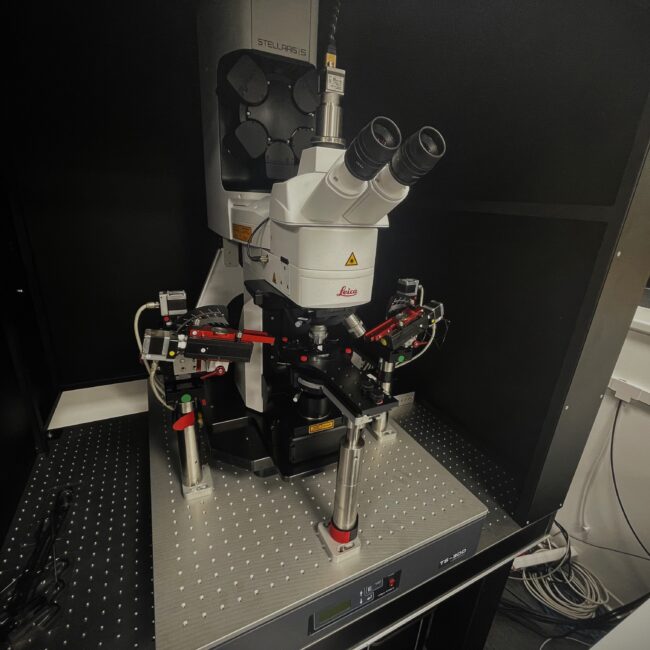
Our recently developed version of this device represents a step forward in experimental research. Our supplied model is fully enclosed and has been carefully designed to perfectly match the specifications of the laboratory and microscope setup with which it is used. Emphasis has been placed not only on functionality, but also on aesthetic appearance – the matte black finish not only gives the cage a modern and professional look, but also ensures long life and wear resistance.
The quality of the materials and workmanship is paramount in our model. The cage is robust and durable, while maintaining the key functionality of isolating the interior from external electromagnetic influences. This feature is essential for performing accurate and reliable experiments, especially in areas where extreme sensitivity to electromagnetic interference is required. In addition to the basic construction, we supply modular components for full coverage.
In addition, because the cage is custom-designed for the specific needs of the laboratory, it can be efficiently integrated into an existing workspace without taking up unnecessary space or complicating integration with other equipment. This design approach allows our researchers to work with maximum efficiency and minimizes potential work interruptions caused by equipment incompatibility.
As a result, our Faraday cage provides an ideal environment for performing sensitive experiments that are crucial to our research programme. Its combination of bespoke design, aesthetic appeal and high performance make it an invaluable tool in our laboratory and a prime example of how innovative engineering can serve scientific progress.
Main Features
- Quality of materials
- Customisation
- Electrical compatibility
- Robust design
- Price

Are you interested?
Looking for a customized solution for your specific needs? Our team of experts are here to provide you with a solution that is a perfect fit for your needs.
Contact us today to discuss your project and discover how our customised solutions can maximise your potential for success.