


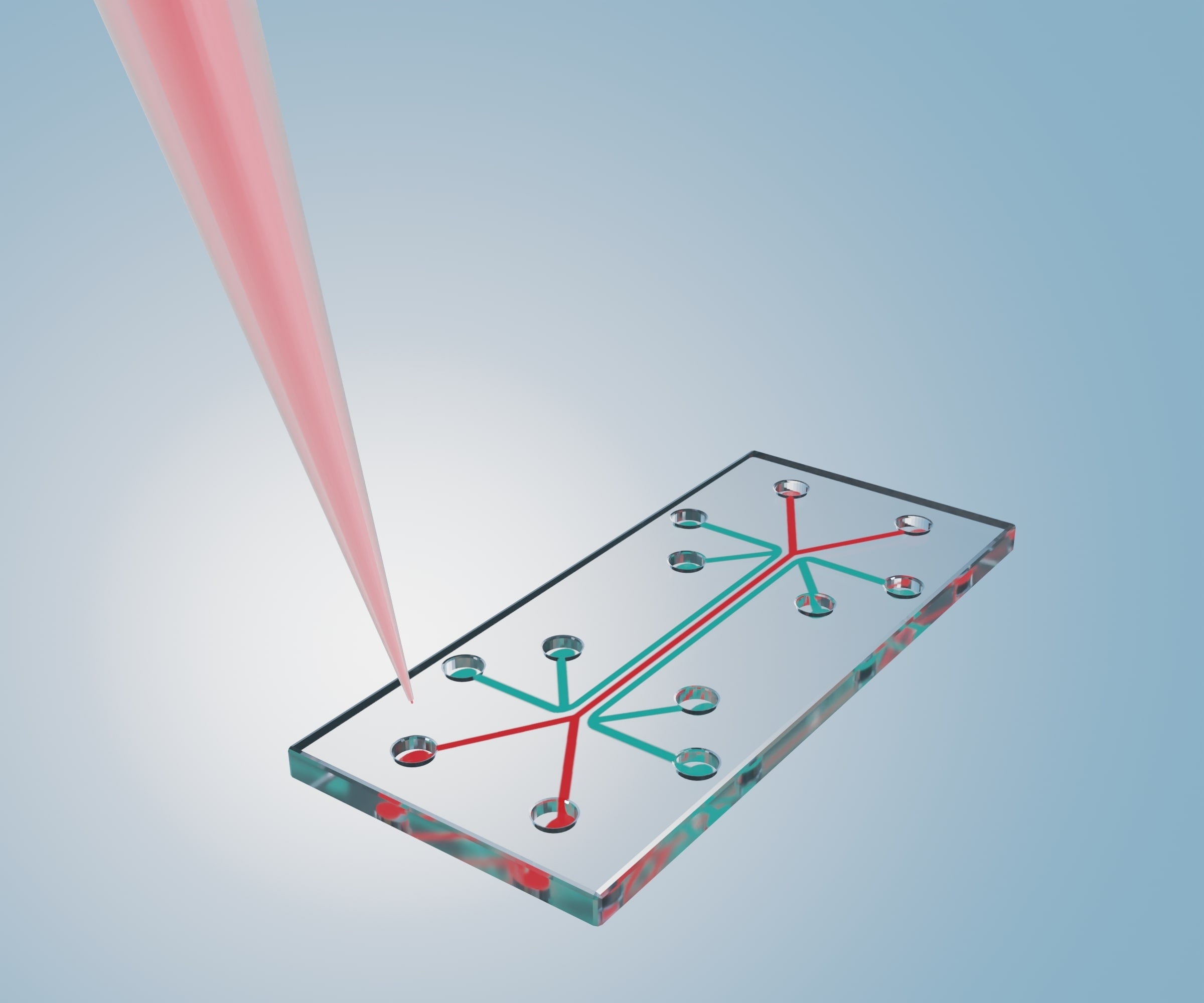
Microfluidic system for cell biology: An invaluable tool for your laboratory
Cell biology plays a vital role in the medical sciences, as it is the basis for innovation and the discovery of new treatments. Advanced microscopy and imaging technologies are key to a thorough understanding of how cells behave during infections and pathological conditions. In recent years, however, microfluidics has come to the forefront of cell research, allowing scientists to better mimic the natural environment of cells, tissues or whole organs by precisely controlling fluid flow.
Microfluidics, using miniature channels to control fluid flow, has become an indispensable tool in a variety of research areas, from studying gene expression in living cells to developing new drug combinations and methods for long-term perfusion studies. Compared to traditional laboratory methods, it offers a number of advantages, including more precise control, higher sensitivity and throughput, cost-effectiveness and lower reagent consumption. With these features, microfluidics has the potential to transform not only cancer diagnostics but also the overall understanding of cancer biology and other pathological conditions.
Fluigent is one of the leading companies specialising in the development and supply of a wide range of microfluidic and nanofluidic systems and components that improve laboratory productivity by offering greater control, automation and precision. Their innovative pressure-based solutions are designed to be compatible with a variety of microfluidic technologies, allowing researchers to focus more on the science and less on preparing experiments. Fluigent thus opens up new possibilities in medical research and biology, giving scientists the tools needed to go beyond traditional methods and achieve breakthrough discoveries.
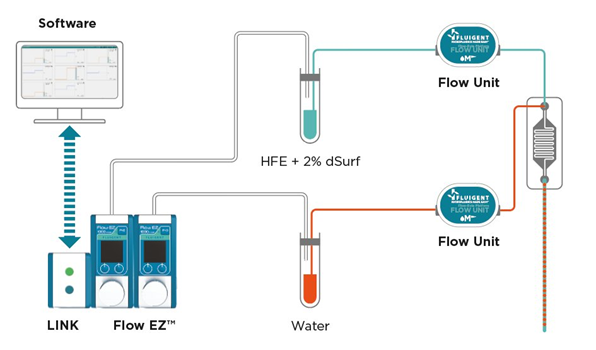
Example of a complete microfluidics solution using a software-controlled pressure source and sensors. A typical setup suitable for a range of basic and advanced experiments. [1]
Fluigent is one of the most innovative manufacturers of pressure flow controllers
An essential requirement for microfluidic systems is the ability to accurately and stably control the flow in microfluidic chips. Fluigent is one of the most innovative manufacturers of pressure flow controllers for life science experiments with great benefits. Pressure flow controllers offer several advantages over peristaltic and syringe pumps in microfluidics for life science applications. One of the main advantages is the precise control of flow rates, which allows better reproducibility and control of experimental conditions. In addition, the pressure control-based system is less susceptible to pulsations and variations in flow, resulting in more stable and consistent flow profiles. The use of pressure controllers in the life sciences also allows scientists to work with much smaller volumes, which is useful when the samples being studied are expensive or rare.

Example of control software for full process automation in a microfluidic system. [1]
The use of compact pumps such as Fluigent’s Flow EZ expands the possibilities for experimentation by allowing the integration of various accessories such as reservoir mixers or block heaters. These additional components help to mimic the physiological conditions of the cells and keep the sample homogeneous, a process that could be significantly more complicated, if not impossible, with other types of pumps. The flexibility and advanced capabilities offered by pressure flow controllers make them invaluable tools for advanced biological experiments where not only accuracy but also the ability to simulate real biological conditions is key. A significant advantage of these systems is also their full automation, allowing easy setup of experimental processes through user-friendly software.
One of the most promising applications of microfluidics is the development of organ-on-chip (OoC) models. These micro-devices mimic the function of human organs using microfluidics and 3D cultures, allowing scientists to better understand how different organs respond to drugs or how different diseases develop. This technology focuses on creating dynamic culture conditions that mimic real-life interactions between different types of tissues and organs. By precisely controlling the environment in which cells grow, scientists can better simulate and study complex biological processes.
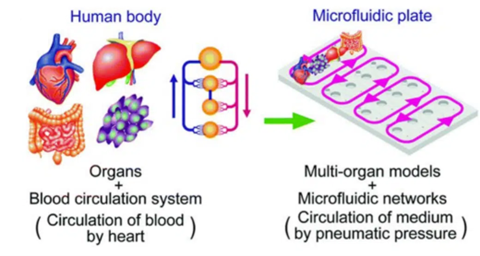
Example of control software for full process automation in a microfluidic system. [1]
In an effort to push the boundaries of organ-on-a-chip research, Fluigent has introduced the Omi platform, which is designed for automated and long-term cell culturing under controlled conditions. The platform offers users the ability to customize protocols for perfusion, recirculation, sampling and injection, enabling comprehensive studies of cellular interactions and processes under realistic conditions.
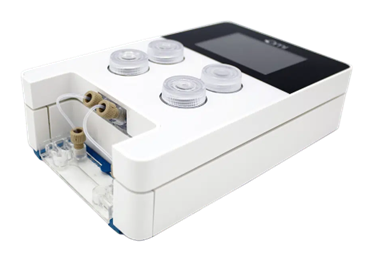
Fluigent’s Lab-on-chip solution platform [1]
Omi is an automated platform designed to reproduce the microphysiological behaviour of organs inside microfluidic chips. It is compatible with any type of chip, allowing it to support different cell culture or organ models on the chip (liver, intestine, skin, etc.). This versatility makes Omi an ideal tool for research that requires the simulation and study of complex biological processes in a controlled microenvironment. With its ability to mimic different types of tissues and organ systems, Omi offers scientists a valuable platform for more accurate understanding of diseases, drug testing and the development of new therapeutic approaches with potential for application in real-world clinical settings.
Our company Vivanto Solutions is engaged in the field of microfluidics and its application in various biological sectors. We offer technical solutions and complete systems for various applications in the fields of cell culture, cell migration and organs-on-a-chip. We will be happy to tailor a solution for you and ensure the design and delivery of a suitable microfluidic assembly for your needs. We can also now offer customized microfluidic chip fabrication. Please do not hesitate to contact us.
Reference: [1] Smart microfluidics (no date) Fluigent. Available at: https://www.fluigent.com/ (Accessed: 24 May 2024).
Are you interested?
Looking for a customized solution for your specific needs? Our team of experts are here to provide you with a solution that is a perfect fit for your needs.
Contact us today to discuss your project and discover how our customised solutions can maximise your potential for success.